Museum of the Future, Dubai
Architecture That Writes the Story of Tomorrow
Dubai is known for its bold architectural gestures, yet the Museum of the Future (MOTF) stands apart as a form that looks imagined rather than constructed. Designed by Killa Design with engineering by Buro Happold, the toroidal structure rises above a landscaped green mound with a façade wrapped in illuminated Arabic calligraphy. Its design has been widely recognised as one of the most complex and innovative structures in the world.

Symbolism in Form — The Hill, The Ring, and The Void
The museum’s architectural narrative is built around three interconnected elements that together express Dubai’s relationship with the past, present, and future. The gently sloping green hill beneath the museum symbolises the grounding force of the earth and the UAE’s cultural history. It also serves the practical purpose of lifting the building above the metro line while offering a rare elevated green space within the city.
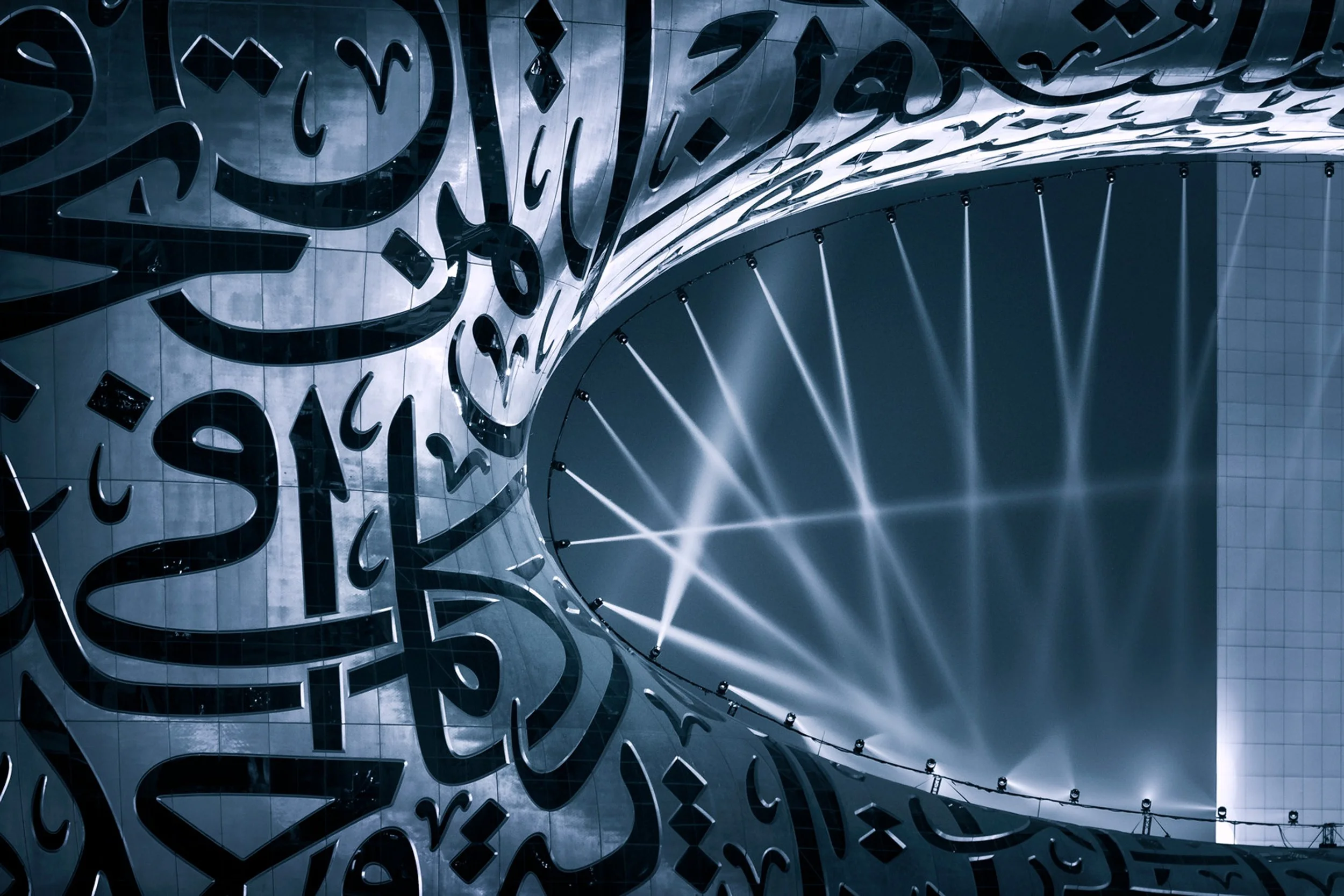
Above it, the reflective torus, fabricated from more than 1,000 robot‑assisted stainless‑steel panels, represents humanity, innovation, and the knowledge we hold today. Its façade is punctured by sweeping calligraphy based on the words of HH Sheikh Mohammed bin Rashid Al Maktoum, designed in the distinctive script of artist Mattar bin Lahej. These calligraphic openings are both symbolic and functional, allowing daylight to filter through the building.
At the heart of the structure, the elliptical void stands as a metaphor for the unknown; a reminder that the future remains unwritten and full of possibility. It is a deliberate absence that forms a powerful contrast with the museum's solid ring and reinforces its role as a vessel for future ideas.

Engineering a Vision — A Feat of Digital Design
The Museum of the Future is not only sculptural but also technically groundbreaking. Standing at 78 metres and encompassing over 30,000 square metres, the building relies entirely on a complex diagrid steel framework that eliminates the need for internal columns. This engineering achievement enables the museum’s vast open interiors and earned it global recognition for structural innovation.
The façade integrates more than 14,000 metres of illuminated calligraphy, with each curve and stroke precisely calculated through parametric design. Digital modelling and full‑scale BIM coordination were essential for achieving the museum’s fluid geometry and perfectly aligned façade panels; a level of complexity that traditional construction methods could not have achieved.
A Sculptural Interior Shaped by Light
A Monumental Entrance
Inside, the museum opens into a bright, fluid, and immersive interior environment. A 16‑metre‑high lobby welcomes visitors with soft white surfaces, continuous curves, and luminous light cast through calligraphic apertures. The sculptural double‑helix staircase rises at the lobby’s centre, echoing the building’s exterior geometry and setting the tone for the journey ahead.
Vertical Movement and Open Volumes
Vertical circulation becomes an integral part of the spatial narrative. Three panoramic bullet elevators move through the full height of the atrium, including one of the world’s largest lifts capable of carrying up to 120 people or large exhibition installations. The column‑free floor plates allow for immersive gallery spaces and dynamic installations, with light continuing to shift throughout the day as it moves across curved walls and reflective surfaces.

Cultural Expression Through Architecture
The building’s calligraphic façade is among its most distinctive features. Beyond its function as fenestration, the calligraphy forms a cultural bridge between the UAE’s heritage and its forward‑looking ambitions. Quotations etched into the façade, such as “The future belongs to those who can imagine it, design it, and build it”, articulate the museum’s central message: the future is something to be shaped, not awaited.

A Global Benchmark for Future‑Focused Design
The Museum of the Future has quickly become internationally recognised as one of the world’s most beautiful and technologically advanced cultural buildings. National Geographic listed it among the 14 most beautiful museums in the world, underscoring its significance not only as an architectural achievement but also as a cultural symbol for Dubai and the UAE. The museum’s use of passive solar strategies, energy‑efficient systems, and building‑integrated renewables reinforces its commitment to sustainable design.

A Building That Imagines Forward
In a city defined by architectural innovation, the Museum of the Future contributes a deeply expressive and visionary new identity. It bridges tradition and technology, symbol and structure, engineering and imagination. More than a landmark, it is an architectural statement about possibility; a declaration that the future is a space to be explored, crafted, and continuously reimagined.

For a deeper look at what it’s like to visit and explore this remarkable landmark, you can discover my full visitor experience guide in Destination Dubai.
More Stories